
A care plan is a monthly fee for a named list of work on a live site. It is not a new website, and it is not a promise that the site will never go down. Freelance designers get into trouble when "maintenance" is left as a feeling. The client hears "anything about the website." You hear "the checks I already run."
Write the list so a client can repeat it. Then make the monthly note match the list. If the note claims work you did not do, the plan is fiction. If the note omits work you did, you will be asked to prove it later from memory.
This is not a legal agreement. Pair the public description with a maintenance agreement the client can sign. Hours, a late fee, and what happens when the plan ends belong in that agreement, in the same words.
Three names a client can say
Basic, Growth, and Pro are enough. More names become a menu nobody remembers.
Basic is watching. The site answers. Domain, hosting, and certificate dates are not a surprise. There is a way to report a break, and they get a ticket id back.
Growth adds a monthly report and a few hours of small edits: a banner, a menu PDF, a paragraph. The hours are a number, not "a few."
Pro adds more hours and, if you run automations for that client, a check that those automations are still running. It does not add a new marketing channel unless you wrote that down.
Say the response time in business hours and name the timezone. "Same day" without hours is how the plan gets argued about in December.
Hours that do not quietly roll
Pick one rule. The simple one is that unused hours do not roll into the next month. The monthly report counts work dated in that month. If you do offer rollover, cap it, and write the cap. Do not leave it implied.
Work outside the list is hourly. When the work can wait, say the price before you do it. A new page, a redesign, a shop, ads, and a full malware investigation are the usual exclusions. Name them. A client who thinks the retainer covers a new landing page will spend the month on that page and then be surprised by an invoice.
Who pays the registrar, the DNS, and the host should be a line in the plan, not a discovery during a renewal week. Watching a date is not the same as paying the bill.
What the monthly note is for
The report is a draft you can edit. It should say the month, the site, the plan name, and the fee if you print fees. It should say uptime for that month in whatever way you actually measure it, the incidents you logged, and the hours against the included amount. If hours went over, say they are billable. If they did not, say they stayed inside the included amount. Do not make the reader do the subtraction.
A line about automations belongs only if you watch them. "No alerts recorded" is a useful sentence. Silence can mean you were not looking. If you were looking, say so.
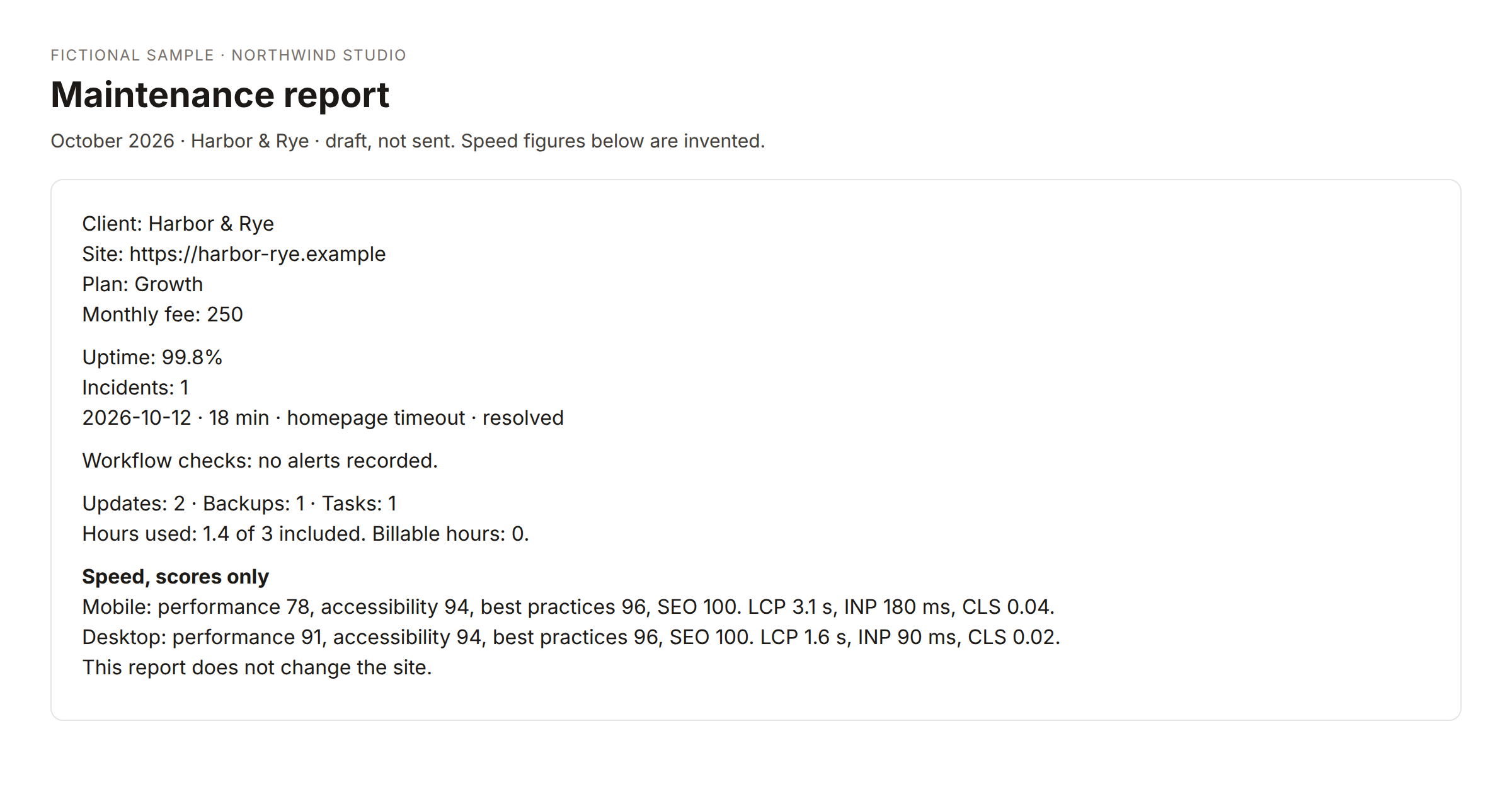
The figure above is a made-up October for a made-up bakery. The speed numbers are not a measurement of a live site. They show where the block sits: under the hours, labeled as scores only.
Speed scores without a speed project
Clients ask about speed because slow pages are obvious. A care plan can include a PageSpeed reading in the monthly note: performance, accessibility, best practices, and SEO, on mobile and on desktop, plus the lab figures for LCP, INP, and CLS when the API returns them.
That block is a reading. It is not a promise to rebuild the theme. It is not a gate that fails the month if the number is under a target. If the URL is missing, the report should say the score was not requested. If the request fails, the report should say it was not available. You can add an API key when volume needs one. You should not pretend a failed call is a score of zero.
Do not sell "I will make it fast" inside the same paragraph. If they want that project, quote it.
How the work is recorded
You need a list of sites that are actually on a plan. Status active is the one you report on. A paused or ended site should not get a client email about a month you did not cover.
Incidents need a start. An incident that is still open at the end of the month can be counted through the end of that month, and you should say that in the line so a 40-minute outage is not written up as a full day by accident. Cap the overlap at the length of the month so the uptime figure cannot go below zero by double counting.
Hours come from a log with a date, a kind of work, and a number of hours. Updates, backups, tasks, and other are enough categories. The report sums dates that fall in the month. It should not reach into last month's unused hours if your rule is no rollover.
Tickets the client opens can land in that same log when you close them and record hours. Then the report does not forget the Wednesday afternoon you spent on a broken form.
What you send, and when
Default to a draft. You read it, you fix a sentence, then you send the link. Auto-send is a switch you turn on after the draft has looked right for a few months. The file name can start with "draft" until that switch is on, so a shared folder does not look like a finished client document.
If neither a per-site folder nor a default reports folder is set, do not email the client a broken link. Tell yourself the numbers and set the folder.
Renewals are a different job from the report. Domain, certificate, and hosting dates can remind you earlier than they remind the client, and the client email should depend on who pays that bill. A date reminder does not log into the registrar and does not edit DNS.
A free draft versus the full month
A short template can turn last month's incident rows into a doc and post you the link, and it can attach a PageSpeed reading. That is a good first month if you have been writing reports in a blank document. It will not compute included hours, and it will not know your plan names unless you type them.
The fuller pack is the site list, the incident log, the hours, the optional overage, and the same speed block. Use the short one to learn the shape. Move to the fuller one when you are billing the hours for real.
The agreement still matters
The plan page and the signed agreement should not disagree about rollover, response time, or who pays the host. When the plan ends, the agreement should say who gets the logins, where the latest backup is, and who pays the domain after that date. The monthly report does not replace that page.
Community version
I used to describe maintenance as "I keep an eye on it." That sentence sold the retainer and then lost the argument about a new landing page.
What I write now is a list. Basic is watching the site and the renewal dates, plus a way to report a break. Growth adds a monthly report and a number of hours that do not roll over unless I say they do. Pro adds more hours and a check that automations are still running, if I run any. New pages and redesigns are outside the list.
The monthly note is a draft I edit. It shows the month, incidents, hours against the included amount, and a PageSpeed reading labeled as scores only. I do not promise to make the site faster in that paragraph. If the score request fails, the note says it was not available.
There is a small n8n template that drafts the doc from incident rows and can attach those scores. The paid setup is the site list and the hours. I would rather the report match the log than sound busy.
I keep the signed agreement next to the plan page so rollover and who pays the host are the same in both. The report does not renegotiate that. It only shows the month.